Clothes Doodle Element: A Designer’s Real-World Embroidery Review
First Impressions: Playful, Hand-Drawn Charm — But Does It Stitch Clean?
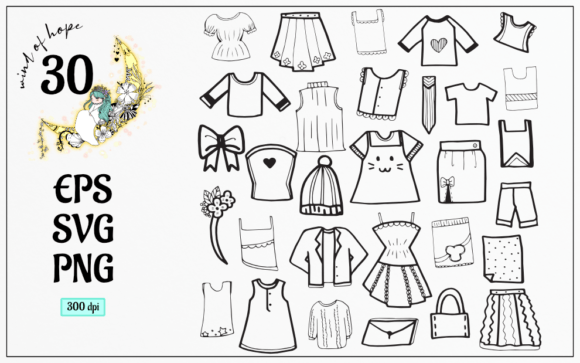
When I opened the Clothes Doodle Element zip file, I wasn’t greeted with photorealism or vector precision—I got something warmer: a set of loose, sketch-style clothing icons—think tiny socks, folded onesies, hangers, buttons, and miniature shirts—all drawn with light, confident linework. The EPS and SVG files hold clean paths, and the 30 PNGs (300dpi, translucent background) are crisp enough for mockups and digital previews. As a designer who’s stitched hundreds of doodle-style graphics onto baby onesies, boutique aprons, and custom tote bags, my first question wasn’t “Is it cute?”—it was “Will this hold up in satin stitch on a lightweight cotton tea towel?”
Where It Shines: Small-Business Projects That Feel Thoughtfully Made
I tested Clothes Doodle Element as part of a holiday gift bundle: embroidered linen kitchen towels for a local maker shop. We used three elements—a tiny hanging dress, a coiled hanger, and a pair of striped socks—scattered across the towel’s lower corner. The result? Instant personality. Customers didn’t just see “embroidered towel”—they saw *care*, *humor*, and *intention*. That’s the quiet strength of this set: it supports handmade storytelling without overwhelming the product.
It works especially well for:
- Personalized baby items — paired with a monogram, a single doodle adds whimsy without competing for attention;
- Embroidered patches — the clean outlines translate beautifully to applique design when backed with medium-weight stabilizer;
- Tote bag designs — scaled at 1.5–2" wide, they sit comfortably beside hand-lettered phrases or brand logos;
- Sweatshirt embroidery — placed subtly on a cuff or pocket edge, they give off that effortless “designed-by-a-human” vibe;
- Etsy listings & printable mockups — the PNGs drop seamlessly into lifestyle shots, helping buyers visualize the finished product before stitching begins.
Where to Pause: Fabric, Scale, and Stitching Realities
This isn’t a one-size-fits-all embroidery file—and that’s okay. Clothes Doodle Element leans into its hand-drawn nature, which means fine lines, open shapes, and intentional imperfections. That charm becomes a challenge on certain substrates:
- Thin or stretchy fabric — delicate linework can blur or pucker if stabilizer isn’t matched carefully. I recommend cutaway + tear-away combo for knits like baby onesies;
- Dark fabric — the doodles rely on contrast. Test thread colors early: soft heathers or charcoal grays may swallow thin running-stitch details unless you bump up density or switch to matte polyester thread;
- Curved surfaces (caps, hats) — avoid placing any element with tight interior corners (like the folded collar on the shirt doodle) near seams or crowns. Those angles tend to distort under tension;
- Small hoop sizes (under 4") — while scalable, some doodles lose legibility below 1". The button motif, for example, reads best at 0.75" minimum;
- Frequent-wash items (baby clothes, kitchen towels) — keep stitch density moderate. Overly dense fill stitches in small areas (like the sock cuff) can stiffen fabric and crack after repeated laundering.
What It Adds to Your Finished Product — Beyond Just “Cute”
As an embroidery designer, I measure value not just in visual appeal—but in how a design affects perception. Clothes Doodle Element quietly elevates professionalism because it doesn’t look mass-produced. Buyers notice the difference: a hand-drawn hanger on a boutique apron signals care in curation, not just production. That builds trust—especially for Etsy sellers and craft fair vendors where handmade presentation directly impacts pricing power and repeat sales.
It also strengthens brand consistency when used intentionally—not as filler, but as a signature accent. One client uses the sock doodle as a subtle watermark on her packaging tags and embroidered labels. It’s become part of her visual language, tying digital assets to physical products without needing a full logo redesign.
Practical Designer Notes Before You Stitch
Before adding Clothes Doodle Element to your next commercial embroidery project or digital product listing, here’s what I always do:
- Test on scrap fabric first — especially if pairing with other elements. See how the line weight holds up next to satin-stitched text or dense fill motifs;
- Review stitch density in your embroidery software — many doodle-style files assume moderate density; adjust if your machine tends toward lighter stitching;
- Check hoop size compatibility — even though the files are vector-based, confirm your intended scale fits comfortably within your smallest working hoop;
- Inspect small details at 200% zoom — look for unintended overlaps or hairline gaps that could cause thread breaks or skipped stitches;
- Mock it up in black and white — helps spot contrast issues before committing thread or fabric;
- Use proper stabilizer — lightweight cutaway for stable wovens, fusible + tear-away for knits;
- Confirm licensing — since this is categorized as Web Elements and Graphics, double-check whether the license permits use in physical embroidered goods sold commercially (e.g., on Etsy) or only in digital-only contexts;
- Compare light vs. dark backgrounds — the PNGs’ translucent background helps, but real-world fabric behavior varies widely.
A Final Thought: Design With Purpose, Not Just Pattern
Clothes Doodle Element won’t replace your core logo or anchor embroidery motif—but it’s the thoughtful detail that makes customers pause, smile, and remember your brand. It fits naturally into projects where warmth matters more than polish: baby shower gifts, craft fair merchandise, personalized nursery decor, or small-batch apparel for local shops. Used with intention, it reinforces authenticity. Used carelessly, it fades into visual noise. So treat it like a design accent—not a crutch. Scale it right. Stabilize it well. And always, always test before you commit to the final garment.